
vastorbit.machine_learning.memmodel.ensemble.GradientBoostingRegressor
- class vastorbit.machine_learning.memmodel.ensemble.GradientBoostingRegressor(trees: list[BinaryTreeRegressor], mean: float = 0.0, eta: float = 1.0)
InMemoryModelimplementation of theGradientBoostingregressor algorithm.- Parameters:
trees (list[BinaryTreeRegressor]) –
listofBinaryTreesfor regression.mean (float, optional) – Average of the response column.
eta (float, optional) – Learning rate.
- Variables:
input (Attributes are identical to the)
underscore (parameters, followed by an)
('_').
Examples
Initalization
A model is an ensemble of multiple binary tree regressors. In this example, we will create three
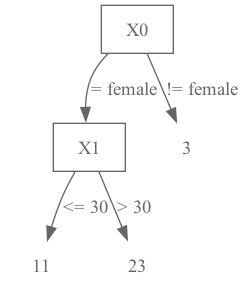
BinaryTreeRegressormodels.from vastorbit.machine_learning.memmodel.tree import BinaryTreeRegressor model1 = BinaryTreeRegressor( children_left = [1, 3, None, None, None], children_right = [2, 4, None, None, None], feature = [0, 1, None, None, None], threshold = ["female", 30, None, None, None], value = [None, None, 3, 11, 23], ) model2 = BinaryTreeRegressor( children_left = [1, 3, None, None, None], children_right = [2, 4, None, None, None], feature = [0, 1, None, None, None], threshold = ["female", 30, None, None, None], value = [None, None, -3, 12, 56], ) model3 = BinaryTreeRegressor( children_left = [1, 3, None, None, None], children_right = [2, 4, None, None, None], feature = [0, 1, None, None, None], threshold = ["female", 30, None, None, None], value = [None, None, 1, 3, 6], )
Now we will use above models to create
GradientBoostingRegressormodel.from vastorbit.machine_learning.memmodel.ensemble import GradientBoostingRegressor model_gbr = GradientBoostingRegressor( trees = [model1, model2, model3], mean = 2.5, eta = 0.9, )
Note
We have used
meanthat represents average of the response column andetathat represents learning rate ofGradientBoostingregressor model. Both are optional parameters.Create a dataset.
data = [["male", 100], ["female", 20], ["female", 50]]
Making In-Memory Predictions
Use
predict()method to do predictions.model_gbr.predict(data)
Deploy SQL Code
Let’s use the following column names:
cnames = ["sex", "fare"]
Use
predict_sql()method to get the SQL code needed to deploy the model using its attributes.model_gbr.predict_sql(cnames)
Hint
This object can be pickled and used in any in-memory environment, just like scikit-learn models.
Drawing Trees
Use
plot_tree()method to draw the input tree.model_gbr.plot_tree(tree_id = 0)
Important
plot_tree()requires the Graphviz module.Note
The above example is a very basic one. For other more detailed examples and customization options, please see Machine Learning - Tree Plots
- __init__(trees: list[BinaryTreeRegressor], mean: float = 0.0, eta: float = 1.0) None
Methods
__init__(trees[, mean, eta])Returns the model attributes.
plot_tree([pic_path, tree_id])Draws the input tree.
predict(X)Predicts using the
GradientBoostingRegressormodel.predict_sql(X)Returns the SQL code needed to deploy the model.
set_attributes(**kwargs)Sets the model attributes.
Attributes
Must be overridden in child class